
The average, annual, full-time employment salary in Arkansas is $25,080 (US Bureau of Labor Statistics). This salary can vary depending on job location and individual competence.
Phlebotomy
TC = Technical Certificate | 27 hours
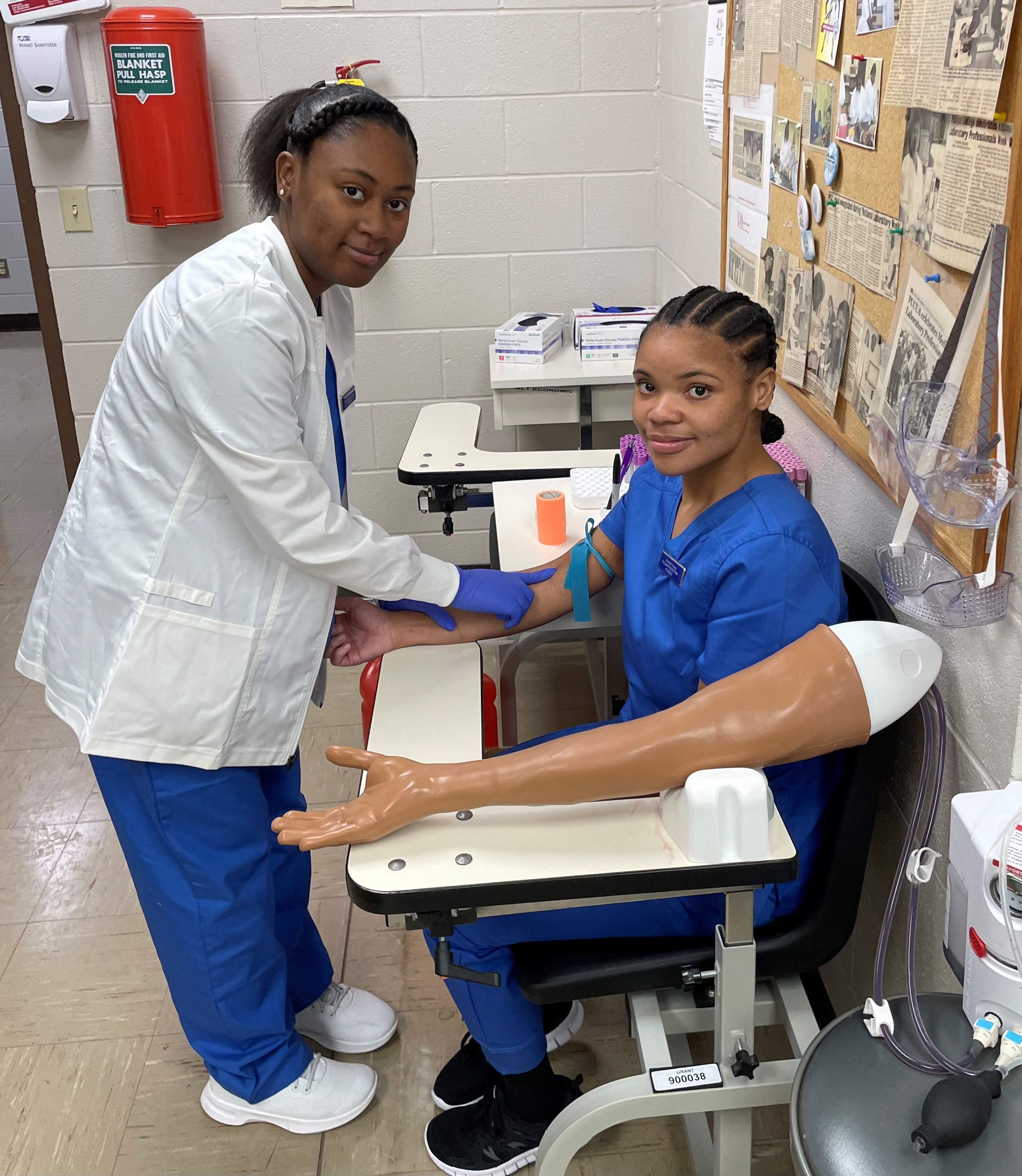
Phlebotomists are a vital part of the healthcare delivery system. They are trained professionals who play a critical role in specimen collection, particularly in obtaining blood samples. Phlebotomists must demonstrate strong technical skills in collection procedures, maintain a high level of professionalism, and communicate effectively with patients and other healthcare professionals.
Possible Careers
- Hospital laboratories
- Blood Services
- Doctor offices
Phlebotomy Mission, Program Outcomes and Program Student Learning Outcomes
Phlebotomy Mission
As an integral part of the larger college system, the Phlebotomy (PLB) faculty endorses the mission of Phillips Community College of the University of Arkansas (PCCUA) which is committed to helping every student succeed. The College provides high-quality, accessible educational opportunities and skills development to promote lifelong learning and engage in the lives of its students and communities (College Catalog). The PLB faculty adheres to that mission when offering the Phlebotomy program. The mission of the Phlebotomy program is to provide a high quality, educational program that prepares the student to achieve entry-level phlebotomy competencies. Graduates are prepared to take the discipline specific entry level national certification exam and practice as ethical and competent phlebotomists.
Program Outcomes
The phlebotomy faculty uses the following program outcomes to measure program effectiveness:
Graduation Rate
Seventy percent (70%) of students enrolled in PLB corses at midterm will complete the program in 100% time.
Certification Pass Rate
Seventy-five percent (75%) of PLB graduates will pass the Board of Certification exam within 12 months of graduation.
Job Placement Rate
Seventy percent (70%) of PLB graduates seeking employment will be employed as a phlebotomist within 12 months of graduation.
Program Student Learning Outcomes
The Phlebotomy faculty uses the following end-of-program student learning outcomes and related competencies to measure student achievement of end-of-program student learning outcomes and related competencies.
- Demonstrate knowledge of the health care delivery system and medical terminology.
- Demonstrate knowledge of infection control and safety.
- Demonstrate basic understanding of the anatomy and physiology of body systems and anatomic terminology in order to relate major areas of the clinical laboratory to general pathologic conditions associated with the body systems.
- Demonstrate understanding of the importance of specimen collection and specimen integrity in the delivery of patient care.
- Demonstrate knowledge of collection equipment, various types of additives used, special precautions necessary and substances that can interfere in clinical analysis of blood constituents.
- Follow standard operating procedures to collect specimens.
- Demonstrate understanding of requisitioning, specimen transport and specimen processing.
- Demonstrate understanding of quality assurance and quality control in phlebotomy.
- Communicate (verbally and nonverbally) effectively and appropriately in the workplace.
Division of Allied Health Criminal Background Checks and Drug Testing
Criminal Background Check
All PCCUA Allied Health programs require each Allied Health student to complete an annual national and State of Arkansas criminal background check, which includes a Social Security and National Sex Offender check, as well as a drug test. All students must complete these requirements through the background check and drug testing provider designated by the College.
In addition, all students assigned to clinical agencies in the State of Mississippi will be required to also complete a criminal background check through the Mississippi Department of Health as directed by the clinical agency. Each respective program director/coordinator will provide the student with specific instructions for background checks through the Mississippi Department of Health. No other criminal background checks will be accepted. The cost incurred for complying with the above policy is the sole responsibility of the student.
If a student has positive results on the VerifyStudents and/or Mississippi Department of Health criminal background check, the respective program director/coordinator will send the student’s positive results to the designated individual(s) at the student’s assigned clinical agency. Representatives from the clinical agency will determine if the student is eligible to access the facility to participate in clinical learning experiences. It is the student’s sole responsibility to provide the designated clinical agency representative(s) with any documentation required to determine eligibility for access.
If representative(s) from the student’s assigned clinical agency deny the student access to the clinical facility, the student will not be able to fulfill respective program requirements in the clinical setting. The student will be required to withdraw from the respective allied health program, and the student will not be eligible for readmission to the respective program or any other PCCUA allied health program. If representatives from the student’s assigned clinical agency allow a student with positive criminal background results to participate in clinical learning experiences in that agency, this does not provide a future guarantee that the student will be allowed to participate in clinical in another agency or that the student will be allowed to take the respective licensing exam.
Students who are dismissed from an allied health program for an unacceptable criminal background check will not be eligible for tuition or fee refunds for allied health courses with a NURS, PNUR, ISHP, MLSC, ALHE, or EMSC prefix.
ALLIED HEALTH DRUG AND ALCOHOL POLICY FOR STUDENTS
Drug Screening Policy
PCCUA will require all allied health students to submit to a drug screening under any or all the following circumstances:
- Pre-clinical Drug Testing – Pre-clinical requirements, at the student’s expense
- Drug abuse recovery program - Annual and random testing will be required at the student’s expense.
- For-Cause Drug Testing – A drug test, at the student’s expense, is required when there is reasonable suspicion and a student’s behavior is characteristic of being under the influence of alcohol or other substances. Such behavior may include, but is not limited to:
- Observed impairment of performance;
- Abnormal conduct or erratic behavior;
- Carelessness or disregard for safety;
- A violation of safe practice;
- Physical signs that are inconsistent with the student’s usual appearance or behavior such as:
o Slurred speech;
o Difficulty walking or standing;
o Unusual appearance or odors;
o Lethargy, drowsiness, confusion, or unusual behavior;
o Impaired coordination, dexterity, or balance.
When a student is required to submit to drug testing under this policy. PCCUA MLT/PLB program requires students to complete Drug Screening conducted by a third-party vendor at designated drug testing facilities. Students are responsible for fees associated with drug screening and failure to meet the deadline for drug screening may result in failure to continue in the MLT/PLB program.
If a student fails a drug screening as required by this policy, the student will be dismissed from allied health programs, and referred to the Vice Chancellor of Student Services and Campus Life. The respective program director/coordinator will review the PCCUA MLT/PLB policy with the student that failed the drug screening for guidance.
Students who are dismissed from any and all PCCUA allied health programs for failing a drug screening test in violation of this policy will not be eligible for tuition and fee refunds for allied health courses with a NURS, PNUR, ISHP, MLSC, ALHE, or EMSC prefix.
Readmission After Positive Drug Test
The readmission process to the same PCCUA allied health program or admission process to another PCCUA allied health program, for a student, who has previously failed a drug test in violation of this policy, to any allied health program will include:
- Attendance at recognized drug treatment program of choice. Evidence of participation must be sent to the Dean of Allied Health and respective program director/coordinator.
- Acceptable evidence from a recognized drug treatment program shall consist of:
o Written record of at least the date of each meeting
o Name of group attended
o Meeting purpose
o Signed initials of the group or district representative of each group attended.
- Acceptable evidence from a drug treatment program of the individual’s choice shall consist of:
o Verifiable completion certificate
- Demonstrate at least six (6) months of drug abuse abstinence immediately prior to readmission to the same allied health program or admission to another allied health program.Testing will be required at the student’s expense.
- Provide positive letters of reference from employers, if any, within the last six (6) months.
- If the student is readmitted to the program or admitted to another allied health program and the student fails another drug screening test, the student will be dismissed from the respective program and will not be eligible for readmission to, or provided a reference for, any allied health program.
- The Allied Health Programs readmission policy.
Program Information
The Phlebotomy Program is a two (2) semester Technical Certificate program. A minimum grade of "C" is required in each phlebotomy course. The Phlebotomy program is approved by the National Accrediting Agency for Clinical Laboratory Sciences. Graduates of the program are eligible to take the national phlebotomy certification examination. Applicants should be aware that violation of any federal, state, or local drug law or conviction of a crime may prohibit the student from entering a clinical agency to care for clients. In addition, clinical facilities also may require a criminal background check and/or drug test as a condition of clinical practice in the respective facility. Inability to complete the clinical course because of failure to meet these requirements will result in course failure.
Admission Requirements
Phlebotomy students are admitted every fall and spring semester to the Helena-West Helena campus. Application must be made to the Phlebotomy program. Students who wish to be considered for admission to the Phlebotomy program must meet the following criteria:
- Fulfill all college admission requirements
- Be at least 18 years of age.
- Submit official high school transcript documenting graduation from high school or official Arkansas High School Diploma/GED certificate and official transcripts from all previously attended colleges to the Registrar’s Office and Phlebotomy Program Director.
- Document a minimum 2.0 cumulative grade point average in all courses taken at PCCUA.
- Provide SAT, ACT, or NG ACCUPLACER scores taken within the last 4 years that meet the minimum skill level in reading, math, and English or complete all required developmental courses prior to making application to the Phlebotomy program.
- Submit completed application to the Phlebotomy Program on the Helena-West Helena campus. The application must be received by the Phlebotomy Program Director on the Helena-West Helena campus by June 1st for fall admission or December 1st for spring admission.
- Students who speak English as a second language must also take the NG ACCUPLACER ESL Exam to prove proficiency in English. PCCUA does not administer the ESL NG ACCUPLACER on campus; however, official ESL NG ACCUPLACER scores from an authorized testing institution may be accepted for placement consideration.
- Rare exception to the admission policy may be made by the Faculty Committee.
All students who meet minimum admission criteria will be accepted unless the number of qualified applicants exceeds space available. This means MEETING THE MINIMUM CRITERIA FOR ADMISSION OR TAKING COURSES REQUIRED FOR THE PLB TECHNICAL CERTIFICATE DOES NOT GUARANTEE ADMISSION TO THE PLB PROGRAM. When the number of qualified applicants exceeds space available, the selection process will be implemented, and admission will become competitive.
Applicants not selected for admission and/or applicants who elect not to enroll in the phlebotomy class must repeat the application process that includes submitting a new application to the phlebotomy program.
Selection Process
- Qualified applicants will be ranked according to the following criteria:
- For applicants with college credit, quality points earned on courses taken at the colleges previously attended or
- For applicants with high school credits only, quality points earned in high school for all completed science and math courses - When two or more applicants have an equal number of total points, applicants will be admitted according to the date and time the application was received in the Medical Laboratory Technology office on the Helena-West Helena campus.
- Quality points for repeated courses will be determined by the most recent grade with 3 quality points subtracted for each repetition.
- Applicants initially not selected for admission will be placed on an alternate list in order of total quality points earned. Spaces that become available before the first day of fall classes will be filled from the alternate list.
Enrollment Process
The student must provide the following documents within two (2) weeks of beginning the Phlebotomy program:
- Completed Health Statement
- Proof of immunization compliance
- Current Td
- Two (2) Varicella or positive titer
- Two (2) MMR, if born after 1957 or positive titer
- Initiation of Hepatitis B series or positive titer - Proof of TB skin test within the last year
- Signed Communicable Disease Statement
- Current US Federal or State issued photo ID (driver’s license, military ID, passport)
- Proof of liability insurance
- Healthcare CPR
After Enrollment
- Proof of Influenza (flu) immunization is required by November 1st of the fall semester
Comply with clinical affiliation agreements and facility policies pertaining to COVID.
Any student who does NOT meet each expectation will NOT be allowed to attend clinical in an affiliated agency and may NOT be able to meet respective course requirements. This policy is effective for students enrolled in allied health and nursing courses.
Any student testing positive for COVID-19 will follow PCCUA’s and the clinical agency’s protocol BEFORE being allowed to return to class and the clinical setting.
Essential Functions of a Phlebotomist
In order to participate in a medical laboratory science education program, which includes phlebotomy, students must be able to comply with program designated essential functions, or request reasonable accommodations to execute these essential functions. Requirements include:
A sound intellect
Good motor skills
Eye-hand coordination and dexterity
Effective communication skills
Visual acuity to perform macroscopic and microscopic analyses or to read procedures, graphs, etc.
Professional skills such as the ability to work independently and to manage time efficiently
To comprehend, analyze and synthesize various materials
Hold sound psychological health and stability
Reference
American Society for Clinical Laboratory Sciences [ASCLS] (n.d.) Essential functions.
As retrieved from https://ascls.org/how-do-i-become-a-laboratory-professional/
Program Accreditation
The Phlebotomy Program is accredited by the National Accrediting Agency for Clinical Laboratory Sciences (NAACLS).
NAACLS may be contacted at:
5600 N. River Rd., Suite 720
Rosemont, Illinois 60018
Phone: 773-714-8880
Web Site: http://www.naacls.org
Program Textbook Requirements
Title | Author | ISBN# |
Phlebotomy Essentials, 8th ed. | McCall | 97812842634802 |
Student Workbook for Phlebotomy Essentials, 8th ed. | McCall | 9781284263565 |
Program Outcome Data
The faculty of Phillips Community College of the University of Arkansas Phlebotomy Program uses the following criteria as measures of PLB program effectiveness, as defined by the National Accrediting Agency for Clinical Laboratory Sciences. (NAACLS Standard IV.A.1.d).
Graduation Rate Outcomes
For graduates between July 1, 2022 and June 30, 2023 | For graduates between July 1, 2023 and June 30, 2024 | For graduates between July 1, 2024 and June 30, 2025 |
75% (6/8) | 60% (3/5) | 56% (5/9) |
Certification Outcomes
| For graduates between July 1, 2022 and June 30, 2023 | For graduates between July 1, 2023 and June 30, 2024 | For graduates between July 1, 2024 and June 30, 2025 |
| 100% (4/4) | | |
Placement Rate Outcomes
| For graduates between July 1, 2022 and June 30, 2023 | For graduates between July 1, 2023 and June 30, 2024 | For graduates between July 1, 2024 and June 30, 2025 |
| | | |
3-year average: 85% (11/13)
General Information
Program Disclosure:
By achieving accreditation from the National Accrediting Agency for Clinical Laboratory Sciences (NAACLS),the Medical Laboratory Technology (MLT) and Phlebotomy (PLB) Programs at Phillips Community College of the University of Arkansas (PCCUA) meet the eligibility requirements for the American Society for Clinical Pathology Board of Certification examination. PCCUA has not determined if the MLT and PLB programs at PCCUA meet the state education requirements for licensure in any other state, any U.S. Territory, or the District of Columbia that may require it. Contact the state regulatory agency in any other state for which this information is needed.
According to the American Society for Clinical Pathologists (ASCP) the following states require licensure for Phlebotomists: https://www.ascp.org/careers-fellowships/careers-in-the-laboratory/phlebotomist#:~:text=How%20to%20become%20a%20Phlebotomist,Washington%2C%20Nevada%2C%20and%20Louisiana(opens in a new tab)
California
California Department of Health Services
Laboratory Field Services Personnel Licensing Section
850 Marina Bay Pkwy Bldg P, 1stfloor
Richmond, CA 94804
Phone: 510-620-3834
Fax: 510-620-3697
Louisiana Clinical Laboratory Personnel Committee
Louisiana State Board of Medical Examiners
PO Box 30250
New Orleans, LA 70190-0250
504-524.6763 ext 261
504-568-6820
http://www.lsbme.la.gov/licensure/clinical-laboratory-personnel(opens in a new tab)
Nevada
Nevada Bureau of Licensure and Certification
1551 College Parkway #158
Carson City, NV 89710
Phone: 702/687-4475
Fax: 702/687-6588
Washington
Washington Department of State Health
Town Center 2
111 Israel Rd. S.E.
Tumwater, WA 98501
360-236-4700
Campus Contacts
Julie Pittman | Director, MLT/Phlebotomy Programs
Helena-West Helena
Carriell Brown | Behavioral Health & Psychology Instructor
Stuttgart
Christina Garner | Advisor & Faculty, MLT/Phlebotomy Programs
Helena-West Helena
Expand
Close All